The History and Evolution of Light Painting Art
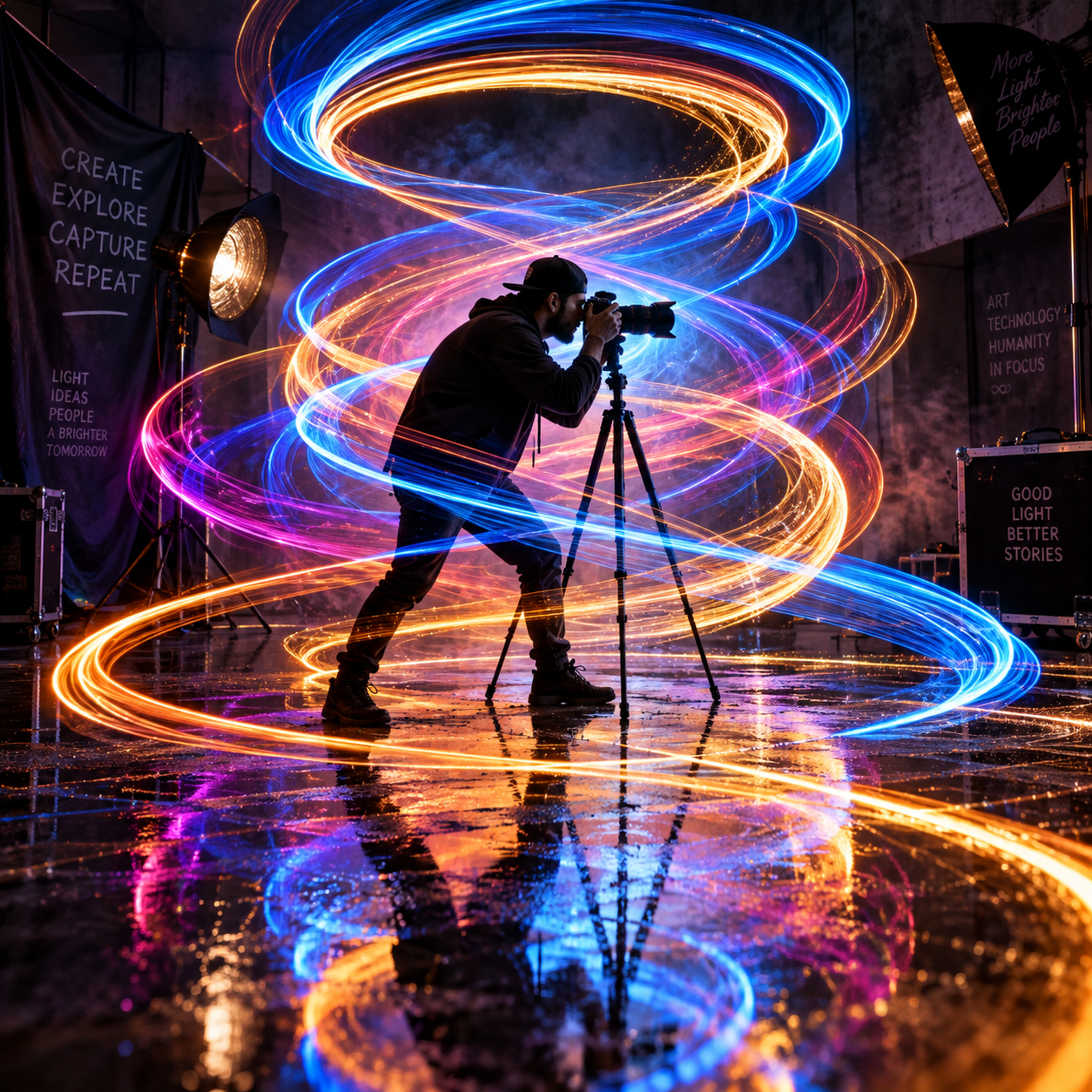
Light painting photography turns moving illumination into a visible record of time. Across more than a century, artists and photographers have used darkness, long exposures, and handheld light sources to draw, reveal, outline, or transform subjects inside a single image.
What Is Light Painting Art?
Light painting art is a photographic process in which a moving light source is recorded during a long camera exposure. Darkness hides the photographer or surrounding space while the sensor or film preserves the path, color, and intensity of the light.
The term covers two closely related approaches. In one, the photographer uses a flashlight, LED, sparkler, or another handheld light source as a brush, drawing shapes in the air. In the other, the photographer illuminates a stationary subject from different directions during the exposure. Both depend on the same relationship between movement, exposure time, and darkness.
A light painting image may contain abstract ribbons, recognizable lettering, glowing outlines, or carefully lit objects that appear to have been painted into existence. The camera does not capture a single instant in the usual sense. It accumulates light over several seconds or minutes, allowing time itself to become part of the composition.
Early Experiments With Light and Photography
Early light painting developed from the long exposure times of nineteenth- and early twentieth-century photography. Because early photographic plates and film were less sensitive than modern digital sensors, photographers often exposed images for extended periods, creating opportunities to record movement and changing illumination.
Long-exposure photography first made motion visible in familiar ways: blurred figures, softened water, and streaked vehicle lights. The same principle allowed a moving lamp or flame to leave a continuous trace across the image. What began as a technical limitation gradually became an artistic possibility.
Early photographic experiments also encouraged artists to think of the camera as a device that could record events invisible to the unaided eye. A person waving a light in a dark room could create a line that existed only during the exposure. The resulting photograph preserved that temporary gesture after the light itself disappeared.
Historical accounts do not always separate deliberate light painting from scientific photography, motion studies, or accidental light trails. That uncertainty matters. The practice emerged through overlapping experiments rather than one universally agreed invention. Its foundations included sensitive photographic materials, controlled darkness, stable cameras, and an expanding curiosity about how photography could represent movement.
For context on early photographic processes and their development, the Library of Congress photography collections provide useful evidence of the changing relationship between photographic technology and visual experimentation.
Pioneers Who Shaped Light Painting
Man Ray, Pablo Picasso, and Frank and Lillian Gilberth each contributed to the history of light painting through different uses of light, movement, and photographic recording. Their work shows that light painting grew from several artistic and experimental traditions rather than a single school.
Frank and Lillian Gilberth
Frank and Lillian Gilberth are associated with early motion studies that used photographic methods to analyze movement. In these experiments, small lights attached to workers’ bodies could produce lines and arcs during a long exposure. The purpose was analytical: to study efficiency and movement in industrial tasks.
Although the Gilberths were not creating light painting as a fine-art genre, their photographs demonstrated how a camera could transform physical action into luminous diagrams. Their work helped establish an important visual idea: motion could be mapped through light.
Man Ray
Man Ray explored photography as an experimental medium, working across surrealism, abstraction, and unconventional image-making. His light-related experiments are often discussed in connection with the broader use of photographic exposure to reveal traces, movement, and invisible processes.
His importance lies partly in the way he challenged the assumption that a photograph should simply describe a fixed object. Through manipulation, unusual exposures, and darkroom experimentation, Man Ray helped broaden the artistic language available to photographers working with light.
Pablo Picasso
Pablo Picasso became widely associated with light-drawing photographs made with photographer Gjon Mili in the late 1940s. Picasso drew figures and symbols in the air with a small light while Mili used long exposure to record the luminous gestures.
These images brought light drawing to a large public audience. They also clarified the difference between an ordinary light trail and an intentional artwork: the trail could carry recognizable ideas, symbols, and the personality of the person making it.
The Development of Light Painting Techniques
Light painting techniques developed as photographers learned to control where light appeared, how long it remained visible, and whether it described motion or illuminated a subject. These choices created the main visual languages still used today.
- Drawing with light: A moving lamp creates letters, symbols, figures, or abstract lines in the frame. The photographer often works backward or upside down because the camera records the gesture differently from normal viewing.
- Creating light trails: A moving point of light produces continuous streaks that suggest speed, rotation, or flowing energy. Headlights, sparklers, LEDs, and fiber-optic tools can all create different trail qualities.
- Outlining subjects: A light source traces the edge of a person, vehicle, sculpture, or architectural form. This approach can make the subject appear illustrated against a dark background.
- Illuminating objects: The photographer moves a light around a stationary subject during one exposure. The final image combines separate moments of illumination into a unified view.
- Concealing the operator: Dark clothing, careful positioning, and constant movement allow the photographer to work inside the frame without appearing in the finished image.
These techniques involve a creative trade-off. A longer exposure gives more time for complex movement, yet it also increases the risk of unwanted ambient light, overexposure, or accidental subject movement. Historical light painters had to estimate results before seeing the negative; contemporary photographers can review and refine the process immediately.
How Camera and Lighting Technology Changed the Art Form
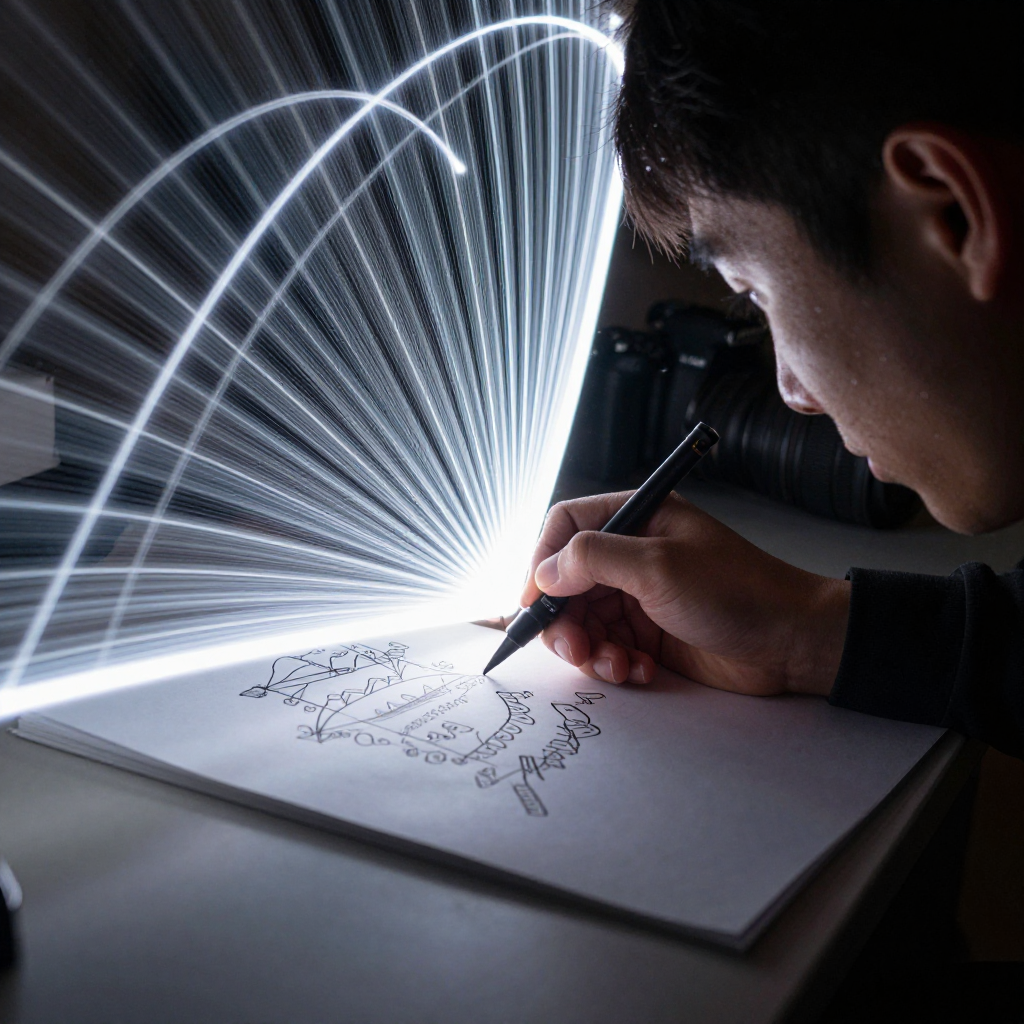
Improved cameras, lenses, film, sensors, and portable lights made light painting more controllable and more expressive. Each technological change expanded the range of subjects, locations, colors, and exposure decisions available to artists.
Film cameras required patience. Photographers had to plan exposure time, aperture, focus, and light intensity with limited feedback. A failed exposure might not be discovered until the film was processed. This restriction encouraged careful choreography and repeatable routines.
More sensitive film stocks and better lenses made it possible to work with weaker light and shorter exposures. Portable battery-powered lamps also replaced some of the bulkier or less predictable light sources used in earlier experiments. The arrival of compact LEDs was especially influential because LEDs offered low heat, long battery life, and precise color options.
Camera settings remain central to the process. A low ISO can reduce unwanted noise, a narrow aperture can help manage bright light, and a shutter speed of several seconds or longer allows movement to accumulate. These are not fixed rules, because the correct settings depend on the brightness of the tool, the location, and the intended visual density.
Digital cameras added a major advantage: immediate review. Photographers could inspect the image, change the exposure, reposition the light, and try again within minutes. The compromise was that digital sensors made it easier to over-rely on trial and error. The strongest work still begins with a visual plan rather than random movement.
Light Painting in the Digital Photography Era
Digital photography made light painting widely accessible by combining instant feedback, affordable equipment, and powerful editing software. A modern practitioner can create convincing work with a camera, tripod, manual focus, a dark space, and a simple handheld light source.
Digital sensors allow photographers to test exposure and color balance without waiting for film processing. RAW files preserve more information for later adjustment, while editing programs can refine contrast, remove accidental marks, or combine multiple exposures. Some artists preserve a single-camera exposure as a matter of discipline; others use compositing to build complex scenes from separately controlled light passes.
Online communities also changed how the practice evolved. Tutorials, image-sharing platforms, and specialist groups allowed photographers in different countries to compare light painting techniques, invent tools, and develop shared terminology. This exchange accelerated experimentation with programmable LEDs, pixel sticks, colored gels, light brushes, and fiber-optic attachments.
Accessibility has not erased the value of craft. A cheap flashlight can produce a compelling photograph when the artist understands composition, timing, color contrast, and visual rhythm. Expensive equipment may provide more control, but it cannot decide where the light should travel or why the image should exist.
The Future of Light Painting Art
The future of light painting art will likely combine programmable lighting, precise motion control, projection, and hybrid photographic processes. These tools can increase repeatability while preserving the central pleasure of making a temporary gesture visible.
Programmable lights already allow artists to control color changes, flashing patterns, and sequences during a single exposure. Motion-controlled rigs can move a light along repeatable paths, making geometric forms and layered compositions easier to construct. Projection can add imagery or texture to a subject while a camera records the interaction between projected light and physical space.
Artificial intelligence and computational photography may also influence the field by assisting with planning, exposure analysis, and image assembly. Yet automation introduces a question of authorship. If software generates the path, color, and timing, the photographer’s role shifts from direct performer to designer of a visual system.
The enduring foundation remains unchanged: a camera records light over time, darkness provides contrast, and movement becomes an image. From the Gilberths’ motion studies to Picasso’s luminous drawings and today’s digital light trails, the history of light painting photography is a history of artists testing what a photograph can remember.
Frequently Asked Questions About Light Painting Photography
What is the history of light painting photography?
Light painting photography grew from early long-exposure experiments that recorded moving light as streaks and diagrams. It later developed through artistic work by figures such as Man Ray and Pablo Picasso, followed by major expansion during the digital photography era.
Who pioneered light painting art?
No single person can be identified as the sole pioneer. Frank and Lillian Gilberth used light traces for motion studies, Man Ray explored experimental photographic processes, and Pablo Picasso helped popularize intentional light drawing through his collaborations with Gjon Mili.
How does long exposure make light painting possible?
Long exposure keeps the camera sensor or film receptive to light for an extended period. As a handheld light source moves, its changing position is recorded as a continuous line, while stationary areas remain dark or receive separate illumination.
What equipment is used for modern light painting?
Modern light painting commonly uses a camera with manual controls, a sturdy tripod, manual focus, a remote shutter release, and a handheld light source such as an LED flashlight, light wand, or programmable tool. Additional equipment changes color, diffusion, texture, or movement.
How has digital photography changed light painting?
Digital photography provides immediate image review, flexible ISO settings, RAW capture, and convenient editing. These features reduce the cost of experimentation and make complex light painting techniques easier to refine, although artistic planning remains essential.